Why Is Machine Mold Quality Important for Buyers?
For buyers, machine mold quality is not a cosmetic detail. It shapes part accuracy, production stability, and the cost of keeping a line running. A mold may look flawless in a showroom. The real test comes after thousands of cycles. Does it hold dimensions? Does it release parts cleanly? Do cooling channels keep cycle times consistent? Small defects can become expensive fast.
Injection-molding consultant John Bozzelli is known for his focus on process consistency. A practical paraphrase of that guidance is: “A mold’s value comes from repeatable parts, not polished surfaces.” This is a paraphrase, not a verified verbatim quotation. Buyers should assess steel selection, machining quality, venting, cooling design, and maintenance access—not just the quoted price. Ask for sample parts and inspection data. Look closely at edges, gate marks, and dimensional results. Those details tell a useful story.
There is a catch. Even a well-built mold cannot compensate for poor setup or unclear specifications. Buyers need to define resin, tolerances, expected volume, and service needs before approval. That conversation can feel tedious. It prevents avoidable surprises. A supplier’s answers matter as much as its sample parts: clear records, realistic timelines, and specific explanations build confidence. Still, no checklist guarantees a perfect tool. Quality needs verification during trials and production, not just promises on a sales sheet.
What Machine Mold Quality Means in Industrial Production
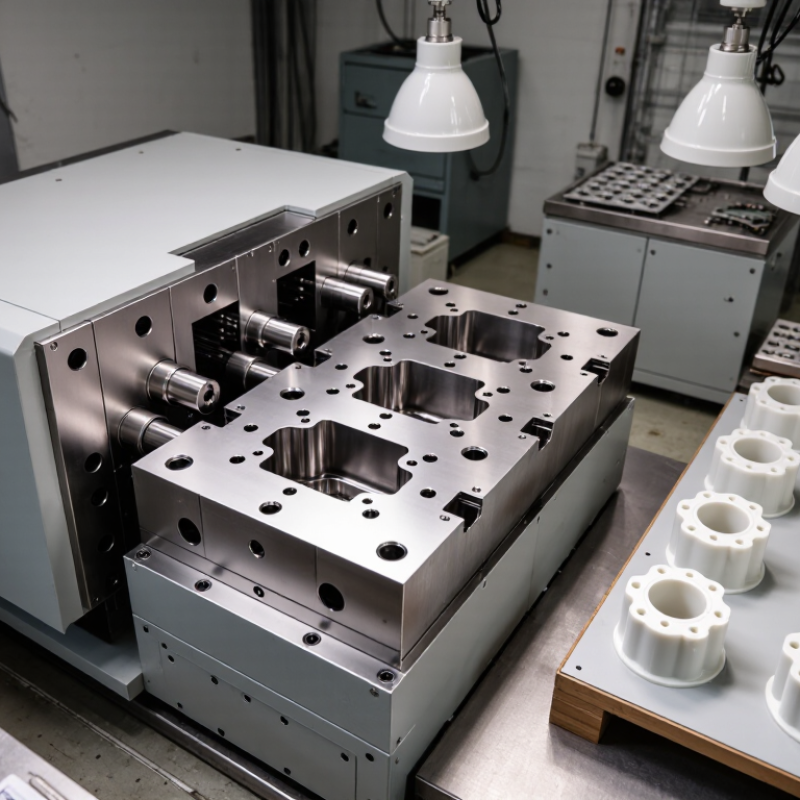
In industrial production, machine mold quality means more than a smooth surface or precise-looking cavity. It is the mold’s ability to produce consistent parts under the conditions it was designed for. Cavity dimensions, alignment, venting, and cooling channels all affect results. A small mismatch at the parting line can leave flash; uneven cooling can cause warping. These defects may appear only after a mold has run for several hours.
Quality is checked through trial runs and repeatable measurements, not appearance alone. Operators can inspect sample parts for dimensions, surface marks, and clean edges, then compare results across shifts. Stable cycles and predictable maintenance intervals also matter because unexpected wear can interrupt production. The details are practical: cooling passages should not be blocked, moving components should travel smoothly, and inspection records should identify wear before it affects output.
No mold stays perfect forever. That sounds obvious, but production pressure can make gradual changes easy to overlook. A mold that works well with one material or cycle setting may perform differently under another. Buyers should therefore consider the intended process, expected production volume, and access to maintenance—not just the initial finish. A clear inspection plan helps connect mold quality to real production needs.
How Mold Quality Shapes Product Accuracy and Consistency
Machine mold quality determines whether a part matches its drawing repeatedly, not just during a successful trial. A worn cavity, uneven cooling channel, or poorly aligned parting line can shift dimensions across a production run. The result may be visible: a clip that will not latch, a thin flash line, or a housing that rocks on a flat surface. Small defects matter.
Consistency comes from controlling both the tool and the process. Stable cavity dimensions, balanced cooling, and reliable venting help each shot form under similar conditions. Buyers can review dimensional inspection records, sample parts from multiple cavities, and checks taken across production—not only a polished first-off sample. Still, inspection alone cannot rescue a poorly maintained mold. Tool history and repair records matter, too.
The American Society for Quality’s cost-of-quality guidance notes that poor quality may consume roughly 5–30% of sales, depending on how costs are counted. That broad range is a warning, not a mold-specific prediction. Deloitte’s 2024 Smart Manufacturing Survey found that 86% of surveyed manufacturers expect smart manufacturing to be a primary competitiveness driver within five years. For mold buyers, process data such as cavity pressure and cooling time can help reveal drift before defects spread. Data helps, but it is not a substitute for careful sampling. A few clean parts can still hide variation.
Why Is Machine Mold Quality Important for Buyers?
How mold quality shapes product accuracy and consistency
This illustrative example shows measurements from 20 parts against a 50.00 mm target and a specified tolerance of ±0.10 mm. A well-made, properly maintained mold helps keep part dimensions consistent; actual results depend on the mold, material, machine settings, and measurement method. The values shown are illustrative, not production test data.
The Impact of Mold Quality on Production Time and Costs
Why Is Machine Mold Quality Important for Buyers?
The Impact of Mold Quality on Production Time and Costs
Mold quality affects more than the first part off the machine. A precise mold can fill evenly, release parts cleanly, and hold dimensions across repeated cycles. That consistency reduces time spent adjusting temperatures, pressure, and cooling settings. It also helps operators avoid stopping the line to inspect batches with flashing, warping, or uneven surfaces.
Small defects can become expensive quickly. A rough cavity may slow ejection, while poor cooling channels can lengthen every cycle. Scrap adds up. If a press runs thousands of cycles, even a few extra seconds per cycle can reduce daily output. Rework, replacement inserts, and unplanned maintenance add further costs. Buyers should ask for sample parts, dimensional inspection records, and details about expected maintenance—not just the mold’s quoted price.
Still, the most elaborate mold is not automatically the best investment. For a short production run, a simpler tool may cost less overall, even if cycle times are slightly longer. Estimates can also miss real-world changes, such as resin variation or a part design revision. A useful comparison includes expected volume, cycle time, repair access, and the cost of downtime. That takes more discussion upfront. It can prevent a rushed repair later.
Why Is Machine Mold Quality Important for Buyers? - The Impact of Mold Quality on Production Time and Costs
| Planning Measure |
Basic Mold |
Well-Maintained Standard Mold |
High-Precision Mold |
| Illustrative initial mold cost |
$15,000 |
$25,000 |
$40,000 |
| Illustrative cycle time |
45 seconds per cycle |
35 seconds per cycle |
30 seconds per cycle |
| Cavities used in this comparison |
2 |
2 |
2 |
| Illustrative unplanned downtime |
8% of scheduled production time |
4% of scheduled production time |
2% of scheduled production time |
| Illustrative reject rate |
3.0% |
1.5% |
0.5% |
| Scheduled machine time for 1,000,000 accepted parts |
About 7,000 hours |
About 5,100 hours |
About 4,300 hours |
| Illustrative scheduled maintenance cost per 100,000 cycles |
$5,000 |
$3,000 |
$2,000 |
| Estimated mold purchase and scheduled maintenance cost to produce 1,000,000 accepted parts |
About $40,800 |
About $40,200 |
About $50,100 |
| Potential buyer impact |
Lower initial investment, but more scheduled machine time and greater exposure to rejects and interruptions. |
Moderate upfront cost with a more balanced production-time and maintenance profile. |
Higher initial investment; shorter modeled production time and lower reject and maintenance assumptions. |
How to read these figures: This is an illustrative planning comparison, not an industry-wide benchmark or supplier quotation. The scenario assumes two cavities, the stated cycle times, downtime and reject rates, and consistent part and process requirements. Scheduled machine time accounts for downtime and rejects. The estimated mold-related cost includes the initial mold cost plus scheduled maintenance over the cycles needed for one million accepted parts; it excludes resin, labor, machine rates, unplanned repair costs and other operating expenses. Actual results depend on part geometry, material, machine, process settings, maintenance practices and acceptance criteria.
Risks Buyers Face When Mold Quality Is Poor
A machine mold can look sound in a quotation photo and still cause trouble on the production floor. Poorly cut cavities may leave flash along parting lines, while uneven cooling can warp a part after it leaves the press. Small defects become expensive. Operators may need to trim parts by hand, adjust settings repeatedly, or stop production to clear stuck components.
The risk is not limited to appearance. Inconsistent cavity dimensions can produce parts that do not fit an assembly, even when individual samples seem acceptable. Weak steel or poor heat treatment may lead to early wear, changing dimensions over time. Poorly placed vents can trap air, leaving burn marks or incomplete fills. These problems increase scrap and delay delivery. They can also make quality checks less predictable from one production run to the next.
Buyers can reduce uncertainty by reviewing trial samples, checking critical dimensions, and asking how the mold will be maintained. A short test run may reveal uneven cooling or difficult ejection before full production begins. Still, a few approved samples cannot prove long-term performance. I have seen buyers focus heavily on the initial price; it is an understandable choice, but it can overlook repair time, replacement parts, and production interruptions. A detailed inspection plan helps, though it cannot prevent every issue.