
Choosing an Air Cooling Chiller in 2026 starts with the conditions at your site, not a catalogue headline. A unit that performs well in a cool test room may struggle beside a sunlit loading bay on a hot afternoon. Outdoor temperature, required water temperature, operating hours, and process heat load all affect the right choice. Small details matter.
This guide explains how to compare cooling capacity, energy use, airflow, sound levels, and maintenance access. Check performance data at conditions close to your actual operation, rather than relying on a single rated figure. Look at the fans, coils, controls, and service clearances. A technician needs room to inspect a coil and reach electrical components without moving nearby equipment. If the chiller will serve changing production loads, ask how it responds when demand falls or rises.
Purchase price is only one part of the decision. Compare expected energy consumption, routine cleaning, replacement parts, warranty terms, and local service support. Request clear documentation, and confirm that quoted capacity matches your design conditions. A spreadsheet helps, but it can miss a blocked louver, a dusty yard, or a future production change. I would not treat any estimate as final until the site conditions and load assumptions have been checked. No shortcut works.
The sections ahead offer a practical framework for weighing these factors and discussing options with suppliers. The best selection is not always the largest or most feature-rich model. It is the unit that reliably meets the cooling requirement, fits the site, and remains manageable to operate over time. A second review can save trouble.
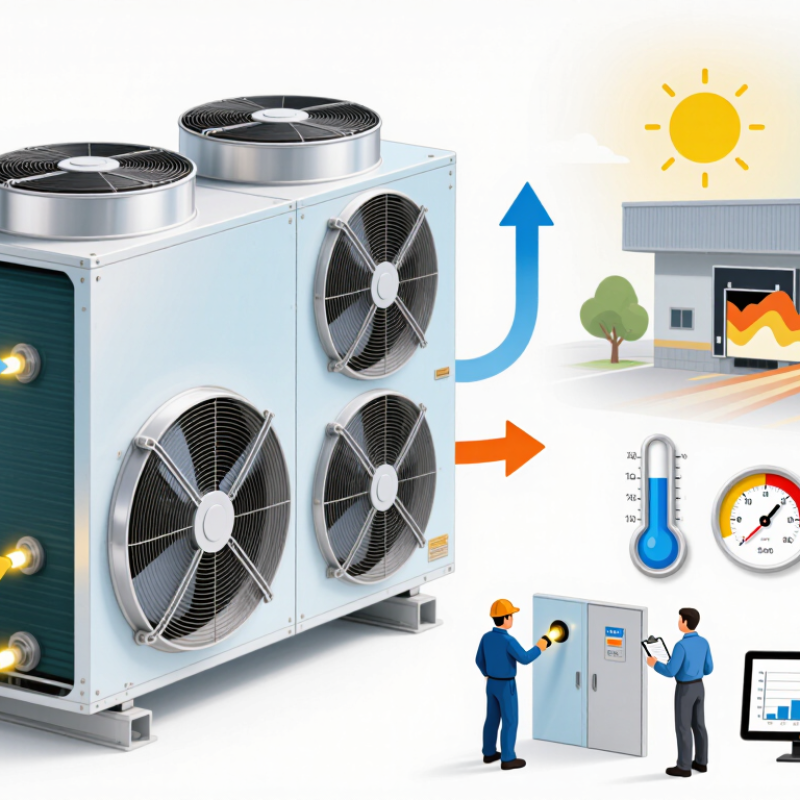
Choosing an air-cooled chiller starts with understanding the process, not comparing catalogue ratings. Record the required supply and return temperatures, plus the acceptable temperature variation during production. A storage tank may need steady cooling, while a cutting machine can create brief heat spikes. Small details matter. Estimate the heat load using equipment data, then check it against real operating conditions where possible. Measure, don’t guess.
Ambient temperature affects an air-cooled unit’s capacity, so use the hottest expected site conditions rather than a mild-day reading. Note the fluid type, concentration, flow rate, pressure limits, and daily operating hours. A glycol mixture, for example, transfers heat differently from water. Check whether one chiller will serve several loads, and whether those loads run at the same time. That can get messy.
Ask operators about dusty surroundings, clogged filters, and access for coil cleaning. These practical issues can reduce available cooling even when the rated capacity looks adequate. Allow a sensible margin, but do not oversize by habit; frequent short cycling can make temperature control less stable. No estimate is perfect. Revisit it after a production trial, using recorded inlet and outlet temperatures, flow, and ambient readings.
Choose chiller capacity from the building’s coincident peak heat load, not the sum of equipment nameplates. Estimate process and comfort-cooling loads, then check actual water flow and the temperature difference between supply and return. For water, a useful check is Q (kW) = 4.186 × flow (kg/s) × ΔT (°C). Small errors in flow or setpoint can change the result. That matters.
Check performance at the site’s summer design temperature, not just the catalog’s nominal capacity. AHRI Standard 550/590-2023 rates air-cooled chillers at 35°C entering condenser air and 6.7°C leaving chilled water under standard conditions. Those are comparison conditions, not a promise of equal output on a hotter roof. Use the manufacturer’s selection data at local design weather; ASHRAE climatic design conditions provide location-specific temperature percentiles for this check. Also account for part-load hours, fouled coils, and likely future loads. Avoid an automatic 20% safety margin: oversizing can cause short cycling and poor humidity control. Leave room. A load estimate is never perfect, so document its assumptions and revisit them when operating data becomes available.
Match chiller capacity to the process heat load and actual operating conditions.
Example sizing illustration: for the same 80 kW heat load, the capacity targets shown include progressively larger allowances as ambient temperature rises. These allowances are illustrative, not universal derating factors. Confirm the chiller’s available capacity at the required leaving-fluid temperature, site design ambient, fluid type, and flow rate before selecting a unit.
Choosing an air-cooled chiller starts with the site, not the catalogue. Axial-fan designs often suit open rooftops, where air can move freely. Centrifugal fans may work better near walls or sound-sensitive areas because they can handle greater air resistance. Check clearances and nearby heat sources; a hot exhaust plume can reduce capacity on a still afternoon. Small detail. Big impact.
Refrigerant choice affects operating pressure, service needs, and environmental impact. Compare the refrigerant’s safety classification and global warming potential, then confirm that trained technicians can support the system over its expected life. Lower impact alone does not make a refrigerant the right choice for every site. Piping, charge size, and equipment design matter too. This part can feel less tidy than a comparison chart suggests.
Efficiency ratings are useful only when their test conditions match your expected operation. Compare full-load figures with seasonal or part-load performance, especially if cooling demand changes throughout the day. Ask for data at your actual entering-water and outdoor-air temperatures. A rating at mild conditions may look excellent, yet tell you little about a hot loading bay in July. Review maintenance access and fan control as well; dusty coils can quietly erode performance. I would still verify the assumptions behind any projected energy savings.
| Comparison area | Option or measure | Useful facts | What to check when selecting |
|---|---|---|---|
| Air-cooled design | Scroll compressor | Commonly used in packaged chillers. Multiple compressors can provide staged capacity and some operating redundancy. | Compare the number of circuits, minimum stable capacity, part-load performance, and whether a compressor failure would reduce or stop cooling. |
| Air-cooled design | Screw compressor | Often used for larger packaged chiller capacities. Capacity can be controlled by compressor unloading or, on some models, variable-speed operation. | Review the certified performance map, turndown, sound data, and efficiency at the expected operating conditions rather than comparing compressor type alone. |
| Heat rejection | Condenser coil and fans | Air-cooled chillers reject heat through a refrigerant-to-air condenser coil. Outdoor air temperature affects condensing conditions and available capacity. | Check capacity at the local design dry-bulb temperature, airflow clearance, fan sound, coil access, and the manufacturer's required service space. |
| Refrigerant | R-410A | ASHRAE safety class A1; high GWP. Its GWP is 2,088 using the IPCC Fourth Assessment Report 100-year values. | Confirm equipment availability, applicable refrigerant rules, service support, and long-term refrigerant plan in the installation jurisdiction. |
| Refrigerant | R-32 | ASHRAE safety class A2L; GWP 675 on the same IPCC Fourth Assessment Report basis. A2L refrigerants are lower-toxicity, mildly flammable refrigerants. | Check the equipment's approved charge, installation and safety requirements, and local code requirements for A2L refrigerants. |
| Refrigerant | R-454B | ASHRAE safety class A2L; GWP 466 on the same IPCC Fourth Assessment Report basis. Suitability depends on equipment design and approval. | Verify that the complete chiller is designed and listed for this refrigerant; do not assume refrigerants are interchangeable. |
| Refrigerant | R-513A | ASHRAE safety class A1; GWP 631 on the same IPCC Fourth Assessment Report basis. It is used in some chiller designs as a lower-GWP alternative to R-134a. | Check the manufacturer's certified capacity and efficiency for R-513A and confirm that the design is specifically intended for it. |
| Refrigerant | R-1234ze(E) | ASHRAE safety class A2L; GWP 6 on the IPCC Fourth Assessment Report basis. It is used in some chiller applications. | Confirm the chiller's operating envelope, safety provisions, servicing capability, and applicable local requirements. |
| Efficiency rating | Full-load COP or kW/ton | COP is cooling output divided by electrical input. For the same operating point, kW/ton = 3.517 ÷ COP; a lower kW/ton indicates less input power per ton of cooling. | Compare ratings at the same leaving-fluid temperature, outdoor air temperature, glycol concentration, and included auxiliary loads. |
| Efficiency rating | IPLV / NPLV | AHRI Standard 550/590 provides methods for rating water-chilling packages, including part-load metrics. IPLV uses prescribed rating conditions; NPLV uses specified nonstandard conditions. | Use the applicable certified rating and verify that its conditions reasonably match the project. A part-load metric is not a guarantee of annual energy use. |
| System selection | Operating profile and installation | Annual energy use depends on load profile, ambient conditions, setpoints, controls, and auxiliary power—not just a single efficiency value. | Size for the calculated design load, assess part-load hours, check electrical service and sound limits, and allow for coil cleaning and maintenance access. |
| Data notes: Refrigerant safety classes follow ASHRAE Standard 34 designations. GWP figures shown use the IPCC Fourth Assessment Report 100-year values and are provided for comparison; values and applicable refrigerant requirements can vary by reporting basis and jurisdiction. Obtain certified chiller ratings and confirm current local regulations before purchase. | |||
An air-cooled chiller can meet the load on paper and still struggle when its site is poorly planned. Walk the proposed location before choosing a unit. Measure available space, roof access, and the distance to nearby walls. The fans need a clear path to discharge hot air; a tight corner can send that air back into the coils. Check the manufacturer’s clearance drawings against actual obstacles, not just the site plan.
Climate changes capacity. Compare the chiller’s rated performance with the local summer design temperature, especially if afternoon sun hits the equipment. Dust, leaves, and salt-laden air can foul coils, so note nearby roads, trees, or coastal exposure. At higher elevations, reduced air density may also affect output. Ask for performance data at your expected conditions. A single nominal rating is not enough.
Noise is site-specific. Review sound data at the property line and near bedroom windows, not only beside the machine. Night operation may need extra attention. Installation matters, too: confirm crane reach, doorway widths, foundation strength, vibration isolation, and service access for coil cleaning. A survey can miss details; ours might, too. Recheck measurements before ordering, and make sure technicians can remove panels without blocking a walkway.
Assess controls, maintenance, compliance, and lifetime costs—not just the purchase price. The International Energy Agency’s The Future of Cooling report estimates that space-cooling demand could more than triple by 2050. That makes part-load performance important: a chiller serving a lightly loaded building should not waste energy cycling or running inefficiently. Ask for performance data across expected operating conditions, not only at full load. Check whether controls can adjust setpoints, stage compressors, and flag abnormal temperatures. A dashboard is useful only when someone reviews it.
Maintenance affects both efficiency and uptime. Compare filter and coil access, cleaning intervals, spare-parts availability, and the service skills required. A blocked coil can be easy to overlook; rising pressure and longer run times may be the first clues. Request a maintenance schedule and a clear warranty response process. For compliance, verify the refrigerant, electrical requirements, noise limits, and local efficiency rules with qualified professionals. Requirements vary by location and can change, so confirm them before specifying equipment.
Tips: Ask suppliers to model annual energy use using your local weather and load profile. Compare energy, service, refrigerant, and replacement costs over the expected life—not just the quoted price. Keep it practical. If the assumptions look too perfect, ask for the calculation.
