2026 Top Types of MIG Welding Machines for Buyers
Choosing a MIG welder in 2026 starts with two practical questions: where will it work, and what will it weld? A compact inverter machine may suit a home garage, while a heavier transformer unit can appeal to shops that value familiar operation. Multiprocess models add stick or TIG capability, but extra functions do not automatically make them the better buy. Keep it simple.
This guide compares the main Mig Welding machine types buyers may consider. They include dedicated MIG units, gas-shielded and flux-cored options, inverter and transformer designs, and multiprocess welders. It also looks at synergic controls and pulse-capable systems, which can help manage settings on suitable materials. Features vary by model, so treat labels as a starting point, not proof of performance.
The right choice depends on material thickness, available power, portability, duty cycle, wire sizes, and access to consumables or service. Check specifications against real jobs, such as joining thin sheet metal or welding steel frames. A high amperage figure alone tells little. Look at torch length, ground clamp quality, spool compatibility, and whether a separate gas cylinder is needed. These details can affect daily use more than a polished product photo suggests. For occasional repairs, easy setup may matter most; production work calls for closer attention to duty cycle and downtime. Price matters, too, but the cheapest machine may bring setup frustration or limited capacity. There is no perfect shortlist. Compare the trade-offs, check manufacturer guidance, and allow some uncertainty before committing.
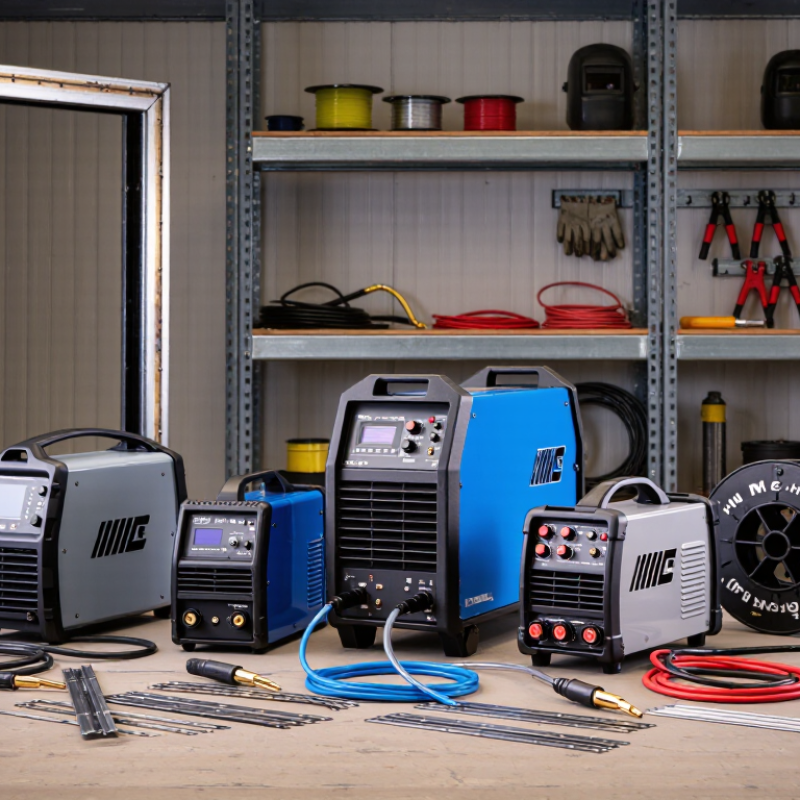
Classify MIG Power Sources: Transformer, Inverter, and Engine-Driven Machines
2026 Top Types of MIG Welding Machines for Buyers
MIG power sources fall into three practical groups: transformer, inverter, and engine-driven machines. Transformer machines use conventional electrical components and are often valued for straightforward construction. Their weight can be a drawback when shop layouts change. They may suit fixed work where ruggedness matters more than easy portability. Older does not automatically mean better.
Inverter machines use electronic controls to convert power, usually allowing a smaller, lighter unit with adjustable settings. This can help when moving between thin sheet and thicker stock, but buyers should check rated output and duty cycle. Engine-driven machines generate power on site, making them useful where grid access is limited. They are heavier, noisier, and need fuel and routine engine care. Match the machine to the work, not just its peak amperage.
Tips: Check input power, wire-feed range, and duty cycle against your usual jobs. Bring a sample material thickness when comparing machines. A tidy specification sheet can still hide an awkward setup.
2026 Top Types of MIG Welding Machines for Buyers — Classify MIG Power Sources: Transformer, Inverter, and Engine-Driven Machines
| Power-source type | How it works | Typical output range | Portability and power supply | Efficiency and controls | Main advantages | Buying considerations and best fit |
| Transformer-based | Uses a mains-frequency transformer and rectifier to convert incoming AC power into welding output. | Commonly found in roughly 150–300 A classes, with the exact range depending on the machine and input supply. | Usually heavy and intended for a workshop or fixed installation. Requires a suitable electrical circuit, often with higher input capacity for higher output. | Generally has a simpler, robust design. Power adjustment may use stepped voltage settings; some models have fewer electronic arc-control features. | Durable construction, straightforward operation, and suitability for regular workshop use. | Consider when the machine will stay in one location and rugged simplicity matters. Check input voltage, circuit requirements, duty cycle, and wire-feed compatibility. |
| Inverter-based | Electronically switches the incoming power at high frequency before converting it to controlled welding output. | Available across a wide range, from compact low-current units to industrial machines rated at several hundred amperes. | Typically lighter and more compact than a transformer machine with comparable output. Models are available for different single-phase and three-phase supplies. | Often offers efficient power conversion, precise electronic adjustment, and features such as inductance control or synergic settings. Actual performance varies by model. | Good portability, flexible settings, and a broad choice of machine sizes and capabilities. | Suitable for fabrication shops, maintenance, and mobile work where size or fine adjustment matters. Verify the input supply, generator compatibility if applicable, rated duty cycle, and service support. |
| Engine-driven | An internal-combustion engine drives an electrical generator that supplies welding power. MIG operation may require a compatible wire feeder and connections. | Many engine-driven welding power sources are designed for higher-output or multi-process work; available MIG output depends on the specific machine and feeder configuration. | Designed for locations without dependable mains power. Usually mounted on a skid, cart, or vehicle and requires fuel, ventilation, and outdoor operating space. | Output and features vary widely. Operation includes engine maintenance, fuel use, noise, and exhaust emissions. | Can provide welding power at remote construction, repair, and field-service sites without a mains connection. | Best for outdoor or remote work. Confirm that the unit supports MIG, whether a feeder is included or separate, available output at the required process setting, fuel capacity, and applicable emissions requirements. |
Buyer note: Output ratings and duty cycles are model-specific. Compare machines using their published ratings at the intended voltage and duty cycle, and confirm that the power source, wire feeder, torch, shielding-gas setup, and input supply are compatible.
Compare Input Options: 120/230 V Single-Phase and 400 V Three-Phase
Input voltage sets a MIG welder’s practical ceiling. IEC 60038:2009 identifies 230/400 V as standardized system voltages; 120 V remains common on North American household circuits. A 120 V, 20 A supply provides about 2.4 kVA, while 230 V at 16 A provides 3.7 kVA. With 400 V three-phase, 16 A per line yields about 11.1 kVA, using √3 × voltage × current. These are apparent-power calculations, not guaranteed welding output. Power factor, efficiency, and the machine’s design reduce usable power. Small jobs? 120 V can handle light sheet metal, but thick sections may demand slower travel or multiple passes.
For buyers, match the machine’s input rating to the actual outlet, breaker, and site supply—not just the voltage printed on its label. IEC 60974-1:2017 covers welding power-source ratings, including duty-cycle information; check that figure at the amperage you expect to use. A 400 V three-phase unit can support higher sustained output, but needs suitable wiring and a compatible supply. A tidy label can mislead. Compare maximum input current, duty cycle, and required protection across models. Also check extension-cord length and conductor size; voltage drop can affect performance. I would not choose on voltage alone. Real workshop loads rarely match a neat calculation.
Assess Wire-Feed Compatibility: 0.6–1.6 mm Solid and Flux-Cored Wire
A MIG machine’s wire range is only useful if its drive system feeds each diameter steadily. The AWS Welding Handbook, 9th edition, Volume 2, describes common solid-wire sizes spanning roughly 0.6 to 1.6 mm. Check the machine’s rated range, then match the drive rolls, liner, and contact tip to the wire. A 0.8 mm wire should sit snugly in its groove; slipping can cause erratic feeding, while excessive pressure can deform it. Small details matter.
Solid wire and flux-cored wire are not interchangeable settings. ISO 14341 classifies solid electrodes for gas-shielded welding; ISO 17632 covers tubular cored electrodes. These standards classify consumables, not machine compatibility, so verify the manufacturer’s stated wire types and diameters before buying. For flux-cored wire, confirm the correct polarity and drive-roll profile; some wires require knurled rolls, while solid wire commonly uses smooth rolls. Fit matters. A machine advertised for 0.6–1.6 mm may not feed every diameter equally well across its full range. Ask for feed-rate guidance at the wire size and process you expect to use, and inspect the liner path for sharp bends that could disrupt feeding.
2026 Top Types of MIG Welding Machines for Buyers
Assess wire-feed compatibility across common solid and flux-cored wire diameters.
The chart shows commonly used nominal wire sizes, not a guarantee that every machine can feed them. Before buying, check the machine’s specified wire range and confirm that the drive rolls, liner, and contact tip match the wire type and diameter.
Compare Synergic, Pulse, and Multi-Process Controls for GMAW
MIG welding machines increasingly offer synergic, pulse, and multi-process controls, but each solves a different shop-floor problem. Synergic control links wire-feed speed and voltage, giving buyers a useful starting point when changing wire or material thickness. The operator can still trim settings. That matters. A preset is not a substitute for checking the actual joint, gas, and wire diameter.
Pulse control alternates current levels to manage heat and metal transfer. On thin stainless or aluminum, it can help limit burn-through and spatter while maintaining a controlled arc. It may also feel different from conventional short-circuit transfer, so operators need time to adjust. Not magic. Test a sample using the same material, position, and joint preparation as the real job. Listen to the arc and inspect the bead; a tidy appearance alone does not prove sound fusion.
Multi-process machines add options such as stick or lift-TIG welding alongside GMAW. That can save bench space for repair teams with varied work, though extra modes may mean more menus and setup checks. Buyers should compare duty cycle, input power, wire capacity, and control clarity—not just mode count. A machine that is easy to set correctly often earns its place faster. I would still leave room for imperfect settings during a first trial.
Evaluate IEC 60974-1 Duty Cycle: 10-Minute Ratings at 40°C
2026 Top Types of MIG Welding Machines for Buyers
Evaluate IEC 60974-1 Duty Cycle: 10-Minute Ratings at 40°C
A MIG machine’s duty cycle tells you how long it can weld within a ten-minute period at a stated output. Under IEC 60974-1, ratings are assessed at a 40°C ambient temperature. A 60% rating means six minutes of welding, followed by four minutes of cooling. It does not mean the machine can weld continuously at that setting.
Check the duty cycle beside the rated current, not as a stand-alone number. A machine may offer a higher duty cycle at lower amperage and a shorter one at maximum output. For example, a shop making repeated passes on thick plate may need more sustained current than a hobbyist joining thin sheet. The numbers matter.
Match the rating to your actual work pattern. Consider pauses for repositioning, wire changes, and fitting parts, but do not rely on breaks to compensate for an undersized machine. Keep the ventilation openings clear, and follow the operating manual. Heat, dust, and restricted airflow can affect performance. Real jobs are messy. I would also leave some capacity in reserve; estimating weld time perfectly is harder than it sounds.
